My friend sent me this question that appears on a manhua. Although I'm not a fan of manhua, I found it pretty interesting to find proof-based math question here. Therefore, as a joke, I want to solve it.
The question: (Image from Player Who Returned 10,000 years later Chapter 117)
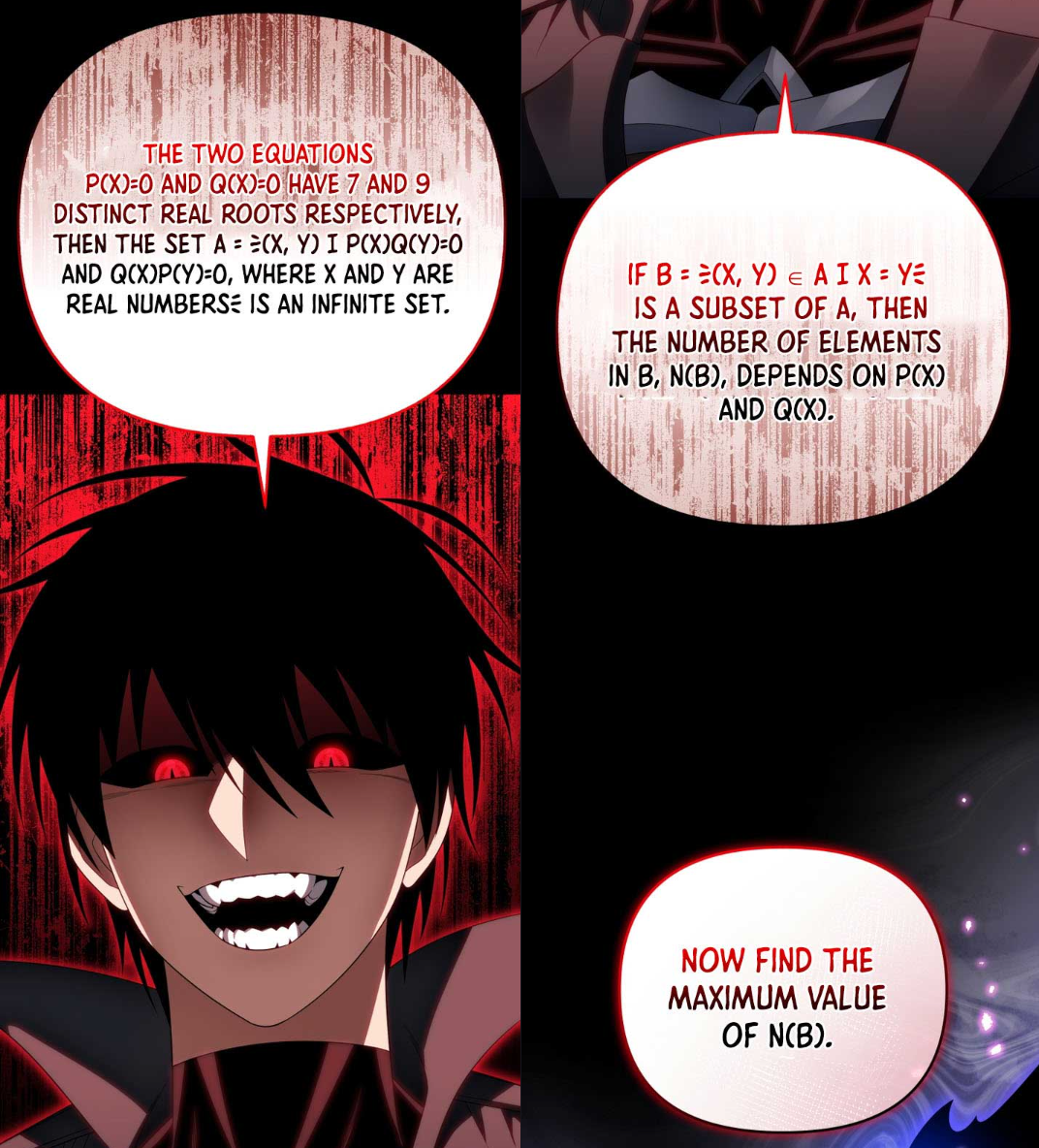
Simplified statement:
Given two real equations \(P(x) = 0\) and \(Q(x) = 0\) has 7 and 9 distinct roots respectively.
Define set \(A = \{(x, y) : P(x)Q(y) = 0 \) and \( P(y)Q(x) = 0\}\) which has infinite elements.
Define subset \(B = \{z : (z, z) \in A\}\). Find the maximum value of \(|B|\).
Given two real equations \(P(x) = 0\) and \(Q(x) = 0\) has 7 and 9 distinct roots respectively.
Define set \(A = \{(x, y) : P(x)Q(y) = 0 \) and \( P(y)Q(x) = 0\}\) which has infinite elements.
Define subset \(B = \{z : (z, z) \in A\}\). Find the maximum value of \(|B|\).
Solution:
Set the roots of \(P(x) = 0\) and \(Q(x) = 0\) as \(p_1, p_2, ..., p_7\) and \(q_1, ..., q_9\). Be careful that there might be duplications in these numbers.
Notice that we can rewrite \(B\) as \(\{z : P(z) = 0 \) or \( Q(z) = 0\}\). This means that \(|B| \leq 7 + 9 = 16\) since it must be one of \(p_1, ..., p_7, q_1, ..., q_9\).
However, we also need to deal with the requirement of \(A\) being infinite set.
Suppose \(P(x) = x(x - 1)...(x - 6)\) and \(Q(x) = x(x + 1)...(x + 8)\). Then \(A\) is infinite since it contains all of \((0, z)\) for any real number \(z\) and \(B = \{-8, -7, ..., 6\}\).
If you find any interesting math problems, please let me know.
Set the roots of \(P(x) = 0\) and \(Q(x) = 0\) as \(p_1, p_2, ..., p_7\) and \(q_1, ..., q_9\). Be careful that there might be duplications in these numbers.
Notice that we can rewrite \(B\) as \(\{z : P(z) = 0 \) or \( Q(z) = 0\}\). This means that \(|B| \leq 7 + 9 = 16\) since it must be one of \(p_1, ..., p_7, q_1, ..., q_9\).
However, we also need to deal with the requirement of \(A\) being infinite set.
Lemma: There is at least 1 duplications in the roots of \(P(x) = 0\) and \(Q(x) = 0\).
Proof: Suppose there is no duplications and all 16 roots are distinct. For any \((x, y) \in A\), we have either \(P(x) = 0\) or \(Q(y) = 0\).
For the first case, since all 16 roots are distinct, we must have \(Q(x) \ne 0\), implies that \(P(y) = 0\). This means that there are \(7 \times 7 = 49\) different \((x, y)\) that satisfies this case.
Similarly, we can deduce that are \(9 \times 9 = 81\) different \((x, y)\) that satisfies the second case.
However, since \(A\) is the union of both, it has at most \(49 + 81 = 130\) different \((x, y)\), contradicting the fact that \(A\) is infinite set.
By the lemma, \(|B| \le 15\). Turns out, we can now construct \(P(x), Q(x)\) that produces \(|B| = 15\). Proof: Suppose there is no duplications and all 16 roots are distinct. For any \((x, y) \in A\), we have either \(P(x) = 0\) or \(Q(y) = 0\).
For the first case, since all 16 roots are distinct, we must have \(Q(x) \ne 0\), implies that \(P(y) = 0\). This means that there are \(7 \times 7 = 49\) different \((x, y)\) that satisfies this case.
Similarly, we can deduce that are \(9 \times 9 = 81\) different \((x, y)\) that satisfies the second case.
However, since \(A\) is the union of both, it has at most \(49 + 81 = 130\) different \((x, y)\), contradicting the fact that \(A\) is infinite set.
Suppose \(P(x) = x(x - 1)...(x - 6)\) and \(Q(x) = x(x + 1)...(x + 8)\). Then \(A\) is infinite since it contains all of \((0, z)\) for any real number \(z\) and \(B = \{-8, -7, ..., 6\}\).